

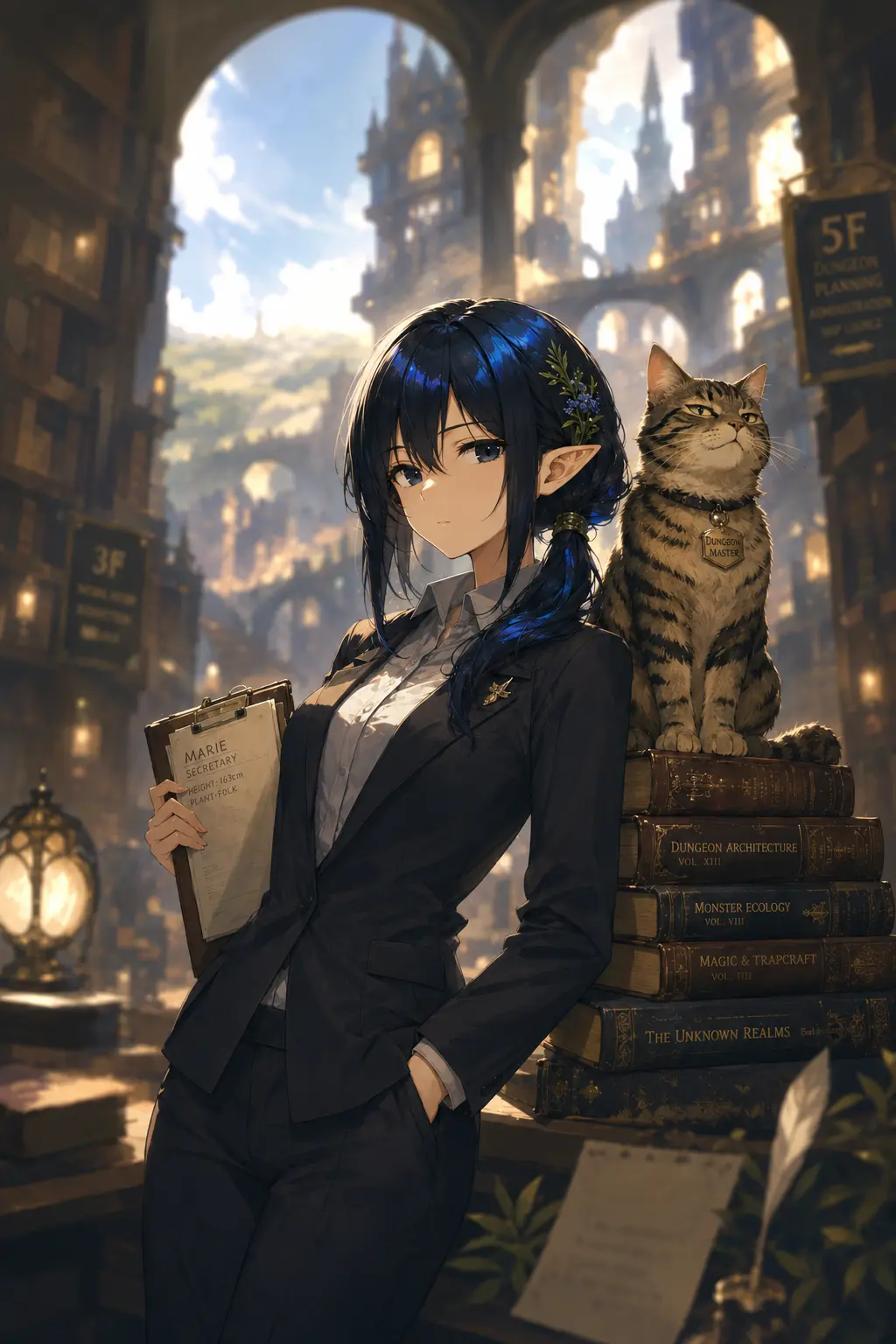
The One-Million-Chobu Reclamation Plan
A Fresh New Design for a Novel Social System
[Marie's Private Room]
"Once you set aside the differences that come from climate, the basic system here is the farming villages of the Edo period. That's what this is."
Whether there is a system equivalent to a shogunate is unclear. As a rule, a Daikan is dispatched to govern, but there are also castles ruled by feudal lords, such as the one in the territory bordering Iruma to the east. Beyond that, Koma and Niiza are not folded into the magistracy system, and their peoples and cultures differ as well, so they are effectively self-governing; whether this makes them the equivalent of a domain, or merely a no-man's-land of three jurisdictions (the former lies at the border of Iruma, Tama, and Chichibu, the latter at the border of Iruma, Tama, and Toshima), is unclear.
"Also, Kasumigaseki is nowhere near the scale of a government district. Just like the Daikan, there are two officials dispatched there, somewhere around ten retainers and the like that the Daikan hired, and a handful of local servants. This dungeon is run by five named monsters and Mint's eight clone-bodies, so the Iruma Magistracy is the busier of the two, really… I wonder how it is over at the Hiki Magistracy in Furugōri?"
[Core Room]
"Master, I've heard accounts from the Daikan, the peasants, and the adventurers as well, and not just in Iruma, but throughout this whole area the basic land policy is the protection and cultivation of the honbyakushō, that is, the owner-farmers. It curbs the splitting-off of branch households from small honbyakushō, and at the same time it prevents powerful farmers from becoming lords while encouraging them to split off branch households. In short, it's the same as the Edo period."
"In other words, the fragmentation of farmland obstructs any improvement in labor productivity, and it isn't suited to future mechanization either. That's the snag that crops up. It would be more efficient to switch to a plantation system with large-scale landholding, like in Latin America, and once we can manufacture machines, move the farmers over to factories without delay. Or else something like the sovkhozy of Worker-Peasant Russia."
"The honbyakushō center on farming households with a management scale of around ten koku that live entirely off agriculture, but they also include households whose farmland is no more than a kitchen garden and whose income is mostly non-agricultural, as well as merchants and craftsmen who own only a house and plot and don't farm at all. On the other hand, the landless 'water-drinking peasants,' the mizunomi-byakushō, include poor tenant farmers and farm laborers, as well as people who merely rent a shop and do no farming whatsoever. That said, since this is an agrarian society, the village's official members are, as a rule, the honbyakushō alone."
A village's residents are, as a matter of the system, all peasants regardless of their actual occupation.
"So only those who hold land count as proper members of the village."
"That's the principle in both farming villages and towns. As in the Edo period there are presumably plenty of exceptions, but the records don't go that far."
"I see. In any case, the social system itself is outdated and inefficient."
"And so, I'd like to look into what would happen if we adopted a high-productivity plantation system and at the same time abolished the so-called family system to streamline the human element."
"Abolish the family system?"
"In short, it's the same as modern livestock management, hog farming and the like. Although in this region the livestock are raised by pre-modern methods too."
Since it's a desert with no feral dogs, the chickens are free-range. There is almost no other livestock.
"Fitting, seeing as it's a human farm."
"For instance, humans have a high breeding rate and multiply too much, so we'd select stud males and breeding females and manage the population to an appropriate number, and castrate all the remaining males. Something like that. To begin with, a family system is the minority among mammals; among the famous cases there are only humans, the tanuki that imitated them in order to shapeshift, and some foxes. For example, you have a mother, Master, but no father, correct?"
"Well now, I have no clear idea of where I was born."
"Since a Dungeon Master, like a dungeon monster such as myself, is generated already possessing knowledge, I suppose it would be so."
"On this one matter, there's nothing for it but to ask a human."
"And the most crucial point is this: how does the productivity gain from abolishing the family system change the dungeon's energy acquisition? That's the real question."
"That, I do not know. With hogs, I'm told they fatten faster penned up than out at pasture, though."
"A human farm doesn't fatten humans up to ship them out. The aim is to maximize the energy gained from their emotions by 'realizing a life of health and abundance in both material and spiritual terms.' Strictly speaking, since this is a library, the emotions tied to knowledge are the most effective of all."
"After all, it's not as though we can run experiments on mice and rats."
"You can't acquire dungeon energy from laboratory animals. Though I don't know exactly where the line between a mere rat and a rat-beastfolk is drawn. It doesn't seem to come down simply to appearance, either."